I still remember standing in the supplement aisle, holding three shiny bottles and feeling oddly confused. One said omega-3, one said krill oil, and one said algae oil. They all sounded healthy, they all promised brain and heart support, and they all looked convincing. If you have ever wondered which one is actually worth your money, you are not alone. And if you want a simple place to track what you eat, how you feel, and what you take, start here: 90 DAYS FOOD AND FITNESS JOURNAL.
Let’s break down the three options in plain English
Here is the simplest way to think about it: omega-3 is the nutrient, and fish oil, krill oil, and algae oil are different ways to get it. The two omega-3s that matter most for health are EPA and DHA. EPA is often linked with heart and inflammation support, while DHA is a big deal for the brain, eyes, and nervous system.
That means the real question is not just which bottle sounds nicest. The real question is: which form gives you the right EPA and DHA for your goal, your diet, and your budget?
OTHER RELEVANT BLOG POST



What makes each one different?
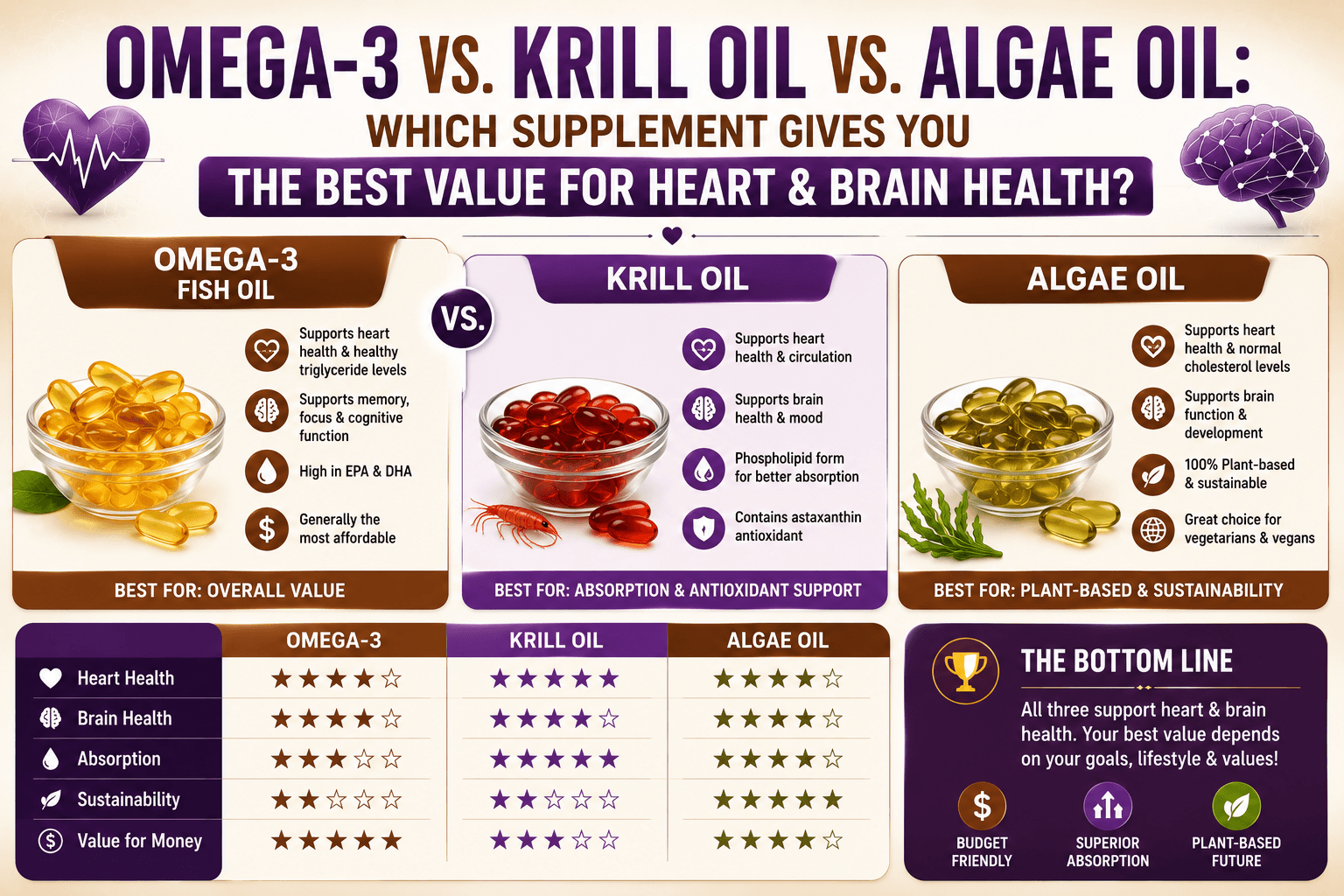
| Form | What it comes from | Best for | Main watch-out |
|---|---|---|---|
| Omega-3 fish oil | Fatty fish like sardines, anchovies, or mackerel | Best overall value and strongest research | Can cause fishy burps or may not suit fish allergies |
| Krill oil | Tiny shellfish called krill | People who want a smaller softgel or prefer a marine source | Usually more expensive, with less total omega-3 per capsule |
| Algae oil | Microalgae | Vegans, vegetarians, and people avoiding fish | Often higher in DHA than EPA, and can cost more than fish oil |
What does the science actually say?
If we look at the evidence with a calm, practical eye, the answer is surprisingly simple: there is no single best form for everyone. The best form depends on what you want most.
Fish oil has the deepest research behind it and is often the most affordable way to get meaningful doses of EPA and DHA. For many people, that makes it the strongest overall choice.
Krill oil is interesting because its omega-3s are packaged differently, which may help absorption for some people. But when you compare the actual health results, krill oil has not clearly outperformed fish oil. It also tends to give you less EPA and DHA per dollar, which matters if you are trying to be practical.
Algae oil is the standout for plant-based eaters. It is a clean, sustainable option and can be a smart choice if you do not eat fish or you want a vegetarian source of DHA. In other words, algae oil is not a second-best option for everyone. For the right person, it is the best option.
If you want to see how omega-3 fits into the bigger picture of daily wellness, you may also like my internal guides on other relevant blog post below
OTHER RELEVANT BLOG POST



So which form is best? Omega-3 vs. Krill Oil vs. Algae Oil:
Here is my honest, no-drama answer:
- Best overall for most people: a quality fish oil with third-party testing
- If you are living vegan or fish-free: algae oil
- Best if you want a smaller softgel and do not mind paying more: krill oil
If your goal is simply to get enough EPA and DHA for preventive health, I would usually choose the form that gives you the best dose, the cleanest testing, and the easiest routine you can stick with. Consistency beats perfection every time.
How to choose the right supplement in 5 easy steps
- Pick your goal. Are you supporting heart health, brain health, pregnancy, or general wellness?
- Check the EPA and DHA numbers. Do not just look at the front label. Turn the bottle around and read the actual amount per serving.
- Look for third-party testing. Search for quality seals or brand transparency from groups like USP, NSF, or IFOS.
- Match the form to your diet. If you avoid fish, algae oil makes life much easier.
- Track how you feel. Use a journal or app to note energy, digestion, and consistency for 30 days.
Where AI can help with preventive health
This is one place where AI can actually be useful without getting in the way. You can use an AI tool to compare supplement labels, summarize ingredient lists, or help you build a simple routine. For example, ask AI to compare two bottles and tell you which one has more EPA and DHA per serving.
That said, AI should be your assistant, not your doctor. Always double-check important details on the bottle and use trusted sources before buying.
Simple tips before you buy
- Choose the supplement based on EPA + DHA, not marketing words on the front.
- If you get fishy burps, try taking it with food or at night.
- On the other hand, if you take blood thinners, are pregnant, or have a health condition, talk with your clinician first.
- If you are vegan or vegetarian, algae oil is often the easiest fit.
- For the most up-to-date evidence, check trusted sources like the NIH Office of Dietary Supplements and NCCIH.
My practical takeaway
If you want the shortest possible answer, here it is: fish oil is usually the best overall value, algae oil is the best plant-based option, and krill oil is a decent but usually pricier middle ground. The science does not give krill oil a clear win over the others, and it does not make algae oil a weak choice either. It all comes down to your needs, your budget, and how well you will stick with it.
For preventive health, the best supplement is the one you understand, trust, and take consistently. That is why I always tell people to keep it simple, track their response, and focus on the basics: sleep, movement, food, stress, and smart supplementation.
FAQ
Is krill oil better than fish oil?
Not clearly. Krill oil may absorb well for some people, but fish oil usually gives you more EPA and DHA for the money and has stronger overall research.
Is algae oil as good as fish oil?
For many people, yes. Algae oil is an excellent source of DHA and sometimes EPA, especially if you want a fish-free option.
Which omega-3 is best for vegetarians?
Algae oil is the best choice for vegetarians and vegans because it comes from microalgae, not fish or shellfish.
Can I take omega-3 every day?
Many people do, but your needs depend on your diet, health goals, and any medications you take. If you are unsure, ask your healthcare professional.
Bottom line: choose the form that fits your life, not just the one with the fanciest label. If you want the best overall value, fish oil usually wins. If you avoid fish, algae oil is a smart, clean alternative. If you like krill oil, it is fine, but I would not pick it first just because it sounds premium. Pick smart, stay consistent, and use AI and simple tracking tools to support your preventive health journey.
Frequently Asked Questions
Is krill oil actually better absorbed than fish oil?
Krill oil is often marketed as being easier to absorb because its omega-3s are packaged differently, but that does not automatically mean better health outcomes. In real-world terms, the bigger question is how much EPA and DHA you get per serving. Fish oil usually delivers more omega-3 for the money and has stronger overall research behind it.
Can algae oil fully replace fish oil if I do not eat fish?
Yes, for many people it can. Algae oil is a very good source of DHA and sometimes EPA, making it the best choice for vegans, vegetarians, and anyone avoiding fish. The main thing to check is the actual EPA and DHA content, since some algae oils are more DHA-heavy than fish-based options.
What should I check on the label besides the front claim of 'omega-3'?
Look at the amount of EPA and DHA per serving, not just the total fish oil, krill oil, or algae oil amount. Those two numbers tell you how much of the active nutrient you are really getting. It is also smart to look for third-party testing, freshness information, and the number of capsules per dose.
Why do some omega-3 supplements cause fishy burps or stomach discomfort?
Fishy burps are usually related to the type of oil, how fresh it is, and how it is taken. Taking capsules with meals or choosing enteric-coated products can help. Krill oil may be easier for some people, but it is not guaranteed to prevent burps. Quality and storage matter a lot too.
If I want the best value, should I always choose the cheapest bottle?
Not necessarily. The cheapest bottle may contain very little EPA and DHA, so you might need to take more capsules to reach a useful dose. A better approach is to compare the cost per gram of EPA and DHA, plus third-party testing and ease of use. Value is about effectiveness, not just price.